
Shiawassee Property Value Types
No single Shiawassee County property value exists. Assessors, equalization staff, and tax collectors each answer a different question. Local assessors set the assessed value. County Equalization reviews the rolls, and Michigan equalization produces the state equalized value, or SEV. Millage applies to taxable value, while a deed may add sale consideration that is not a standing market estimate. Keep the record type and year beside every amount.
| Value type | Meaning in Michigan | Official record |
|---|---|---|
| Assessed value | The local assessment, set at 50 percent of true cash value under Michigan law. | Local assessing roll and BS&A |
| State equalized value | The assessed value after county and state equalization. | Assessment record and notice |
| Taxable value | The value used with millage to compute tax; Proposal A limits annual growth until transfer. | Tax roll and bill |
| Recorded sale consideration | The amount reported with a transfer, subject to the instrument and any exemptions. | Register of Deeds instrument |
Michigan's 50-percent assessment level implies a true cash value near twice the assessed figure. That is a mass-assessment measure, nothing more. It is not a promise about what a buyer will pay. Condition, timing, and financing can all move sale consideration. So can the nature of a transfer. The Michigan property tax guide supplies the governing assessment framework.
Read AV, SEV, and TV Together
Shiawassee County assessment records abbreviate the three headline figures as AV, SEV, and TV. AV reflects the assessor's half-value standard. SEV reflects equalization. TV controls the actual tax calculation after exemptions and statutory limits. Quoting one figure as though it were another is common. That is the fastest way to a wrong comparison.
A sound comparison records the tax year and all three values. It should also capture the principal residence exemption field, the property class, and any sale date shown. The county's BS&A service hub links assessing, current tax, delinquent tax, building, and property-sale searches. Municipal histories vary. Choose the unit that actually assesses the parcel.
Michigan's Half-Value Assessment Rule
Michigan defines assessed value at 50 percent of true cash value. True cash value means the assessor's estimate of the usual selling price. It is not a private appraisal for one transaction. County Equalization keeps assessment levels consistent among local units. Each parcel still sits on its city or township roll.
- True cash value
- The statutory estimate of the property's usual selling price.
- Assessment level
- The ratio between assessed value and true cash value, set at 50 percent in Michigan.
- Equalization
- County and state review used to bring local classes of property to the required level.
- Consideration
- The value or payment stated or reported for a recorded transfer.
Doubling AV gives rough context only. It is not a valuation report, and parcel condition plus current market evidence still matter.
Proposal A Shapes Taxable Value
Taxable value can sit below SEV. Michigan's Proposal A caps annual taxable-value growth while ownership stays unchanged. The cap follows inflation or five percent, whichever is less, apart from additions and losses. Two similar Shiawassee County houses can therefore carry close assessed values. Yet those same houses may hold very different taxable values. That gap is structural, not a market signal.
A transfer generally uncaps taxable value the following year, subject to statutory exceptions. The new figure becomes the base for later capped increases. A sharp TV change after a deed should be tested against the transfer date first. Only then read it as a change in market worth.
Note: A transfer can change taxable value without changing the parcel. It also does not prove that major work occurred.
Recorded Sales Need Deed Context
A last-sale field only helps when it matches the recorded instrument. The Shiawassee County Register of Deeds indexes conveyances by grantor, grantee, year, and Liber/Page. Pull the deed itself. It shows whether the transfer was a warranty deed, quitclaim deed, sheriff's deed, tax deed, administrator's deed, or another instrument. Those categories do not carry the same market meaning.
Search the county land-record index with the parties and an approximate year. Save the recording date and document type. Also note the Liber/Page, legal description, and any stated consideration or transfer-tax detail. Family transfers, estate distributions, corrective deeds, and land-bank conveyances can all show a figure that is not arm's-length. Check the instrument type before trusting the number.
Exemptions Change Tax, Not Market
The principal residence exemption, usually written PRE, reduces the school operating portion of a qualifying home's tax bill. Other exemptions change tax treatment too. None of them alters the parcel's physical features. None establishes its open-market price. Compare like fields when reviewing nearby parcels.
The Michigan PRE program publishes forms, audit material, and denial resources. For a value study, record whether PRE or another exemption appears, then keep that issue separate from AV and SEV. Tax bills and contest procedures belong in the Shiawassee County property tax records workflow.
Look Up Shiawassee Property Value
Start with the official administrative roll for the assessed figures. Turn to the deed index for transfer evidence. An address works as a beginning, but the full parcel number is the safer key when streets, unit names, or mailing cities overlap.
- Open county BS&A, choose the correct municipal unit, and search the situs address.
- Confirm the parcel number and legal description before copying AV, SEV, TV, class, and exemption fields.
- Write down the tax year. Do not compare figures from different years as though they were simultaneous.
- Match the sale date and parties to the most recent relevant deed in the Register's index.
- Use permits or building records only as context for a documented addition, demolition, or alteration.
- Assessed value
- One-half of the assessor's true cash value estimate.
- Taxable value
- The capped value to which tax rates are applied.
- Sale price
- The amount tied to a particular transfer, not a permanent valuation.
The official Shiawassee County BS&A service hub shows how assessing, tax, delinquent-tax, building, and property-sale records branch from the same parcel entry. Every branch follows the parcel.
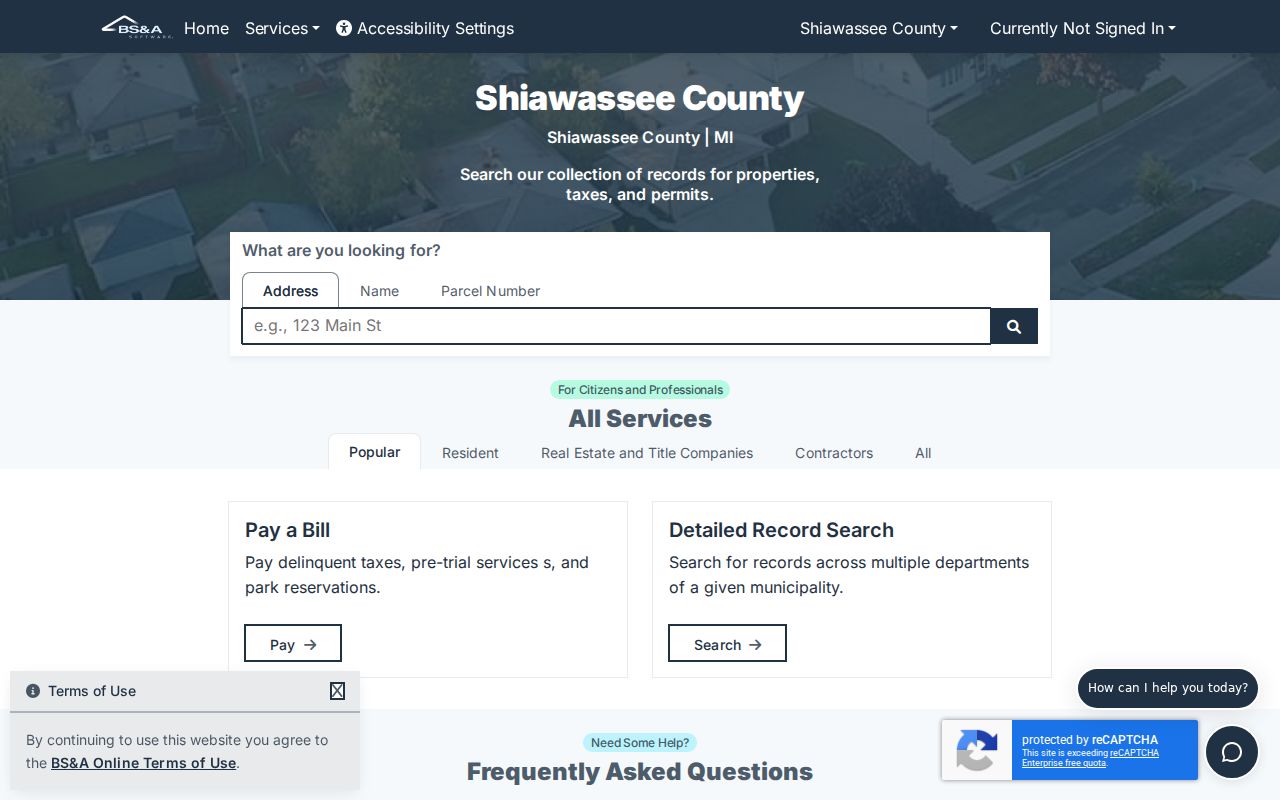
Those linked categories make the parcel number a reliable bridge. The value type and tax year still determine what each displayed number means.
Building Records Add Value Context
Building history adds context to Shiawassee County value figures. BS&A lists a Building Department search category. Owosso, Durand, and Corunna keep their own permit and zoning material. A permit can document an addition or a demolition. It can also show structural work, trade work, or a proposed use. That paper trail often explains why assessment numbers moved. A filed form or fee schedule does not prove the work was ever finished.
Match permits by situs address and APN, not by owner name alone. Corunna's city form is a good example. It asks for the owner, project address, and parcel number. The same form covers work description, proposed use, estimated value, and inspection details. Read any similar permit evidence alongside the final inspection and the assessment year. Skip guessing at the land and improvement breakdown unless the live assessing panel shows it.
Compare Nearby Values with Care
Nearby parcels make useful checks when they share class, location, size, use, and assessment year. They are not automatic comparables. A parcel across the road may sit in another township, school district, or tax unit. A city mailing label can even extend past city limits. FetchGIS helps pin down location, while BS&A carries the administrative values for Shiawassee County parcels.
Write down the subject APN and every comparison APN. Compare SEV and AV before taxable value. TV reflects each parcel's transfer and cap history. Deed type and deed date matter too. This discipline keeps a low taxable value from being mistaken for low market worth.
Equalization Resolves Record Questions
The Shiawassee County Equalization office handles ownership, addresses, legal descriptions, valuation, taxes, millage, exemptions, and land divisions. It is the right fallback when a parcel lands under the wrong unit. It also helps when an online card clashes with a notice. Bring the APN, tax year, legal description, and both disputed figures.
Equalization explains the administrative record. It does not issue title opinions or private appraisals. A recent deed can also record before the assessment owner field catches up. Shiawassee County publishes no fixed update lag. So check any recent ownership or sale question against the newest recorded instrument in the deed records.
Limits of Shiawassee Property Values
An assessed value exists for Michigan's property-tax system. It is not a site-specific appraisal for a purchase, sale, loan, estate, insurance claim, or boundary dispute. Recorded consideration reports one transfer, not current worth. GIS offers spatial context but no survey-grade line.
Use the official value record to understand the assessment year and tax framework. Use the deed to understand the transfer itself. When you need a present market opinion, hire a qualified appraiser who inspects the Shiawassee County property and selects supportable comparable sales.
Value is not price. A Shiawassee County assessed value serves taxation. It does not predict a sale price and is not an appraisal.